THANK YOU FOR SUBSCRIBING


CFO Tech Outlook Weekly Brief
Be first to read the latest tech news, Industry Leader's Insights, and CIO interviews of medium and large enterprises exclusively from CFO Tech Outlook


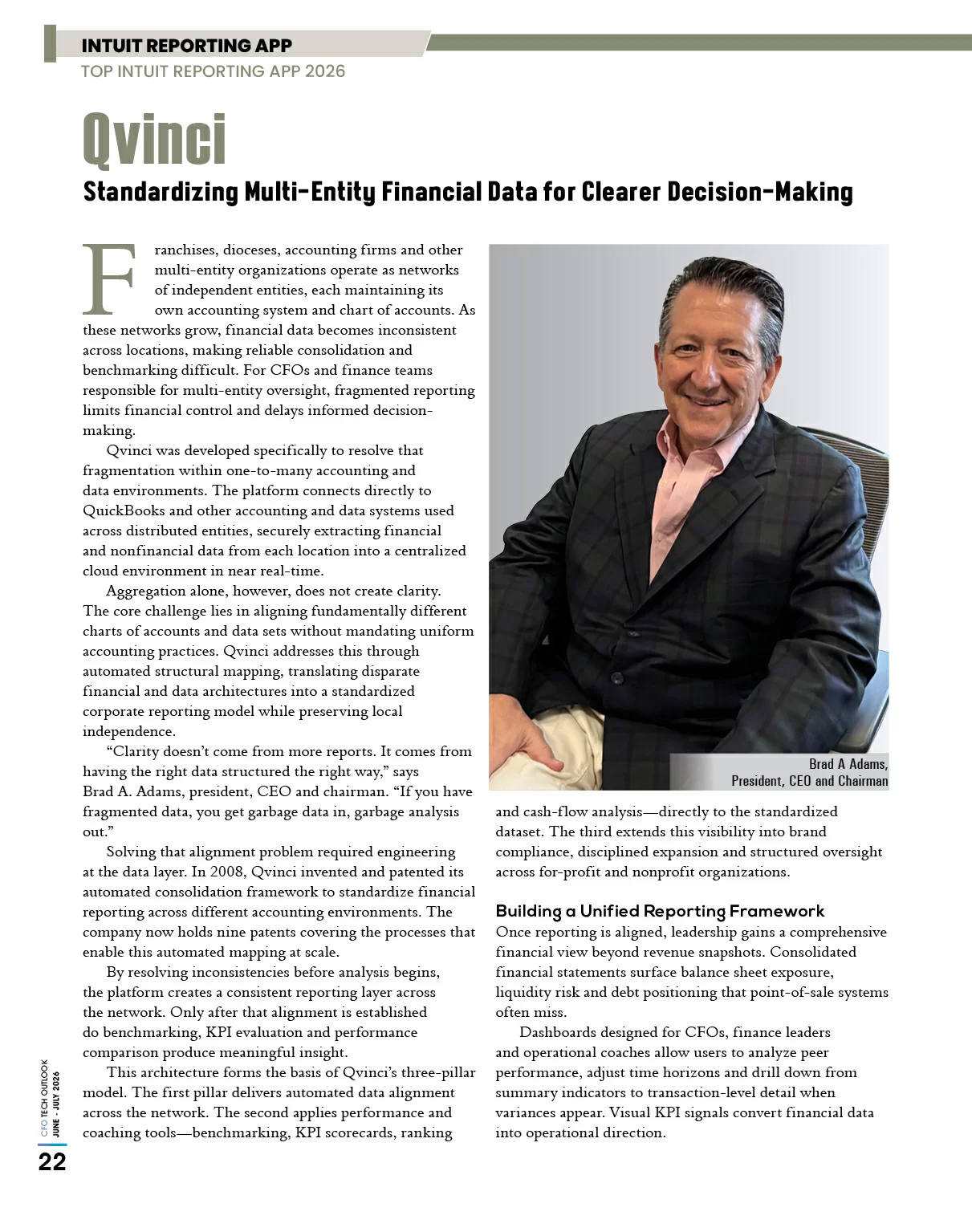
 Brad A Adams, President, CEO and Chairman
Franchises, dioceses, accounting firms and other multi-entity organizations operate as networks of independent entities, each maintaining its own accounting system and chart of accounts. As these networks grow, financial data becomes inconsistent across locations, making reliable consolidation and benchmarking difficult. For CFOs and finance teams responsible for multi-entity oversight, fragmented reporting limits financial control and delays informed decision-making.
How does Qvinci centralize financial and nonfinancial data across distributed entities securely?
Qvinci was developed specifically to resolve that fragmentation within one-to-many accounting and data environments. The platform connects directly to QuickBooks and other accounting and data systems used across distributed entities, securely extracting financial and nonfinancial data from each location into a centralized cloud environment in near real-time.
Aggregation alone, however, does not create clarity. The core challenge lies in aligning fundamentally different charts of accounts and data sets without mandating uniform accounting practices. Qvinci addresses this through automated structural mapping, translating disparate financial and data architectures into a standardized corporate reporting model while preserving local independence.
“Clarity doesn’t come from more reports. It comes from having the right data structured the right way,” says Brad A. Adams, president, CEO and chairman. “If you have fragmented data, you get garbage data in, garbage analysis out.”
Why did standardizing disparate accounting structures require engineering at the data layer?
Solving that alignment problem required engineering at the data layer. In 2008, Qvinci invented and patented its automated consolidation framework to standardize financial reporting across different accounting environments. The company now holds nine patents covering the processes that enable this automated mapping at scale.
 By resolving inconsistencies before analysis begins, the platform creates a consistent reporting layer across the network. Only after that alignment is established do benchmarking, KPI evaluation and performance comparison produce meaningful insight.
This architecture forms the basis of Qvinci’s three-pillar model. The first pillar delivers automated data alignment across the network. The second applies performance and coaching tools—benchmarking, KPI scorecards, ranking and cash-flow analysis—directly to the standardized dataset. The third extends this visibility into brand compliance, disciplined expansion and structured oversight across for-profit and nonprofit organizations.
Once reporting is aligned, leadership gains a comprehensive financial view beyond revenue snapshots. Consolidated financial statements surface balance sheet exposure, liquidity risk and debt positioning that point-of-sale systems often miss.
This visibility supports the push-pull paradigm described by Qvinci, where both corporate leadership and local operators use the same standardized data to identify performance gaps and address them using consistent benchmarks.
That operating model becomes measurable in practice.
Supporting Disciplined Growth and Proactive Risk Oversight
In what way does standardized data improve growth oversight and risk visibility?
When financial and non-financial data is aligned across a network, decision velocity increases. In one multi-location diocese, standardizing expense categories across parishes and schools enabled direct benchmarking, revealing inconsistencies that resulted in a 30 percent reduction in shared operating expenses.
In a healthcare and exercise franchise, aligning balance sheet and P&L data across locations exposed leverage strain that had been masked by strong revenue growth. Applying consistent debt-to-equity benchmarks surfaced risk not visible in point-of-sale reporting, allowing earlier corrective action.
In a home healthcare network, comparable financial benchmarks across locations created a consistent coaching framework. That transparency supported performance improvement and contributed to a 50 percent increase in unit expansion among existing franchisees.
Qvinci is extending this foundation through Qvinci Intelligence, advancing structured reporting into interactive analysis that links summary performance directly to transaction-level detail.
Rather than replacing financial judgment, Qvinci Intelligence guides users from inquiry to interaction and interrogation, narrowing variance drivers and directing them to the underlying transactional data. Emerging capabilities are designed to accelerate root-cause identification while keeping analysis grounded in the standardized dataset.
For multi-entity organizations operating in one-to-many accounting environments, Qvinci automates the collection, consolidation and mapping of fragmented financial data so leadership can analyze performance on a standardized basis and manage risk, performance and expansion with clarity.
| Share this Article: Tweet |

Company
Qvinci
Management
Brad A Adams, President, CEO and Chairman
Description
Qvinci is a cloud-based financial intelligence platform designed for multi-entity organizations. It automates the collection, consolidation and mapping of disparate accounting and non-financial data into standardized reports, and delivers benchmarking and business intelligence that enables performance coaching and compliance oversight. It integrates with existing bookkeeping systems, so there is no need to migrate to an ERP or mid-market accounting solution.