THANK YOU FOR SUBSCRIBING


CFO Tech Outlook Weekly Brief
Be first to read the latest tech news, Industry Leader's Insights, and CIO interviews of medium and large enterprises exclusively from CFO Tech Outlook


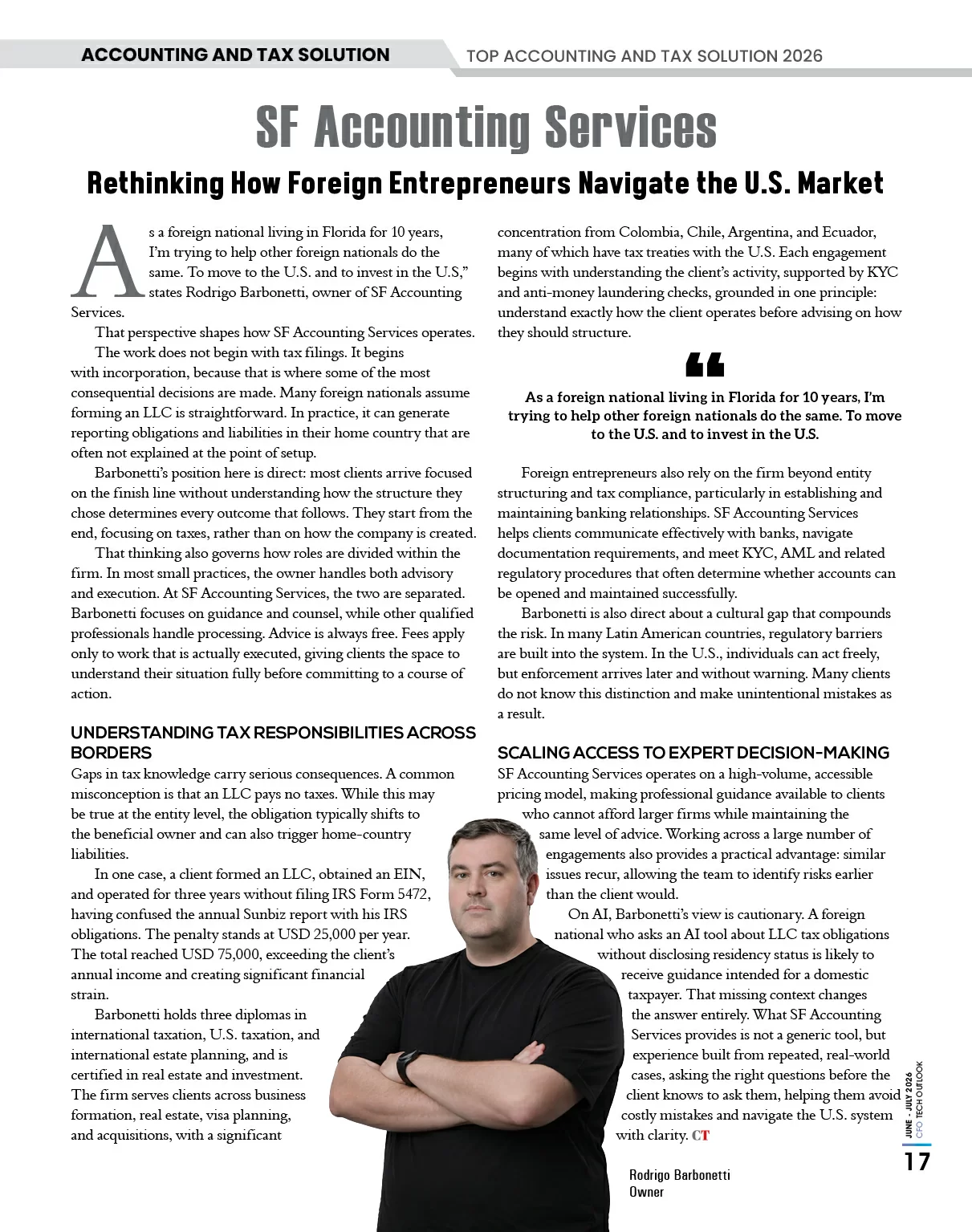
 Rodrigo Barbonetti, Owner
“As a foreign national living in Florida for 10 years, I’m trying to help other foreign nationals do the same. To move to the U.S. and to invest in the U.S,” states Rodrigo Barbonetti, owner of SF Accounting Services.
That perspective shapes how SF Accounting Services operates.
The work does not begin with tax filings. It begins with incorporation, because that is where some of the most consequential decisions are made. Many foreign nationals assume forming an LLC is straightforward. In practice, it can generate reporting obligations and liabilities in their home country that are often not explained at the point of setup.
Barbonetti’s position here is direct: most clients arrive focused on the finish line without understanding how the structure they chose determines every outcome that follows. They start from the end, focusing on taxes, rather than on how the company is created.
That thinking also governs how roles are divided within the firm. In most small practices, the owner handles both advisory and execution. At SF Accounting Services, the two are separated. Barbonetti focuses on guidance and counsel, while other qualified professionals handle processing. Advice is always free. Fees apply only to work that is actually executed, giving clients the space to understand their situation fully before committing to a course of action.
How do cross-border tax obligations create unexpected liabilities for foreign business owners?
Gaps in tax knowledge carry serious consequences. A common misconception is that an LLC pays no taxes. While this may be true at the entity level, the obligation typically shifts to the beneficial owner and can also trigger home-country liabilities.
Why is understanding regulatory, banking, and compliance requirements critical for foreign entrepreneurs?
Barbonetti holds three diplomas in international taxation, U.S. taxation, and international estate planning, and is certified in real estate and investment. The firm serves clients across business formation, real estate, visa planning, and acquisitions, with a significant concentration from Colombia, Chile, Argentina, and Ecuador, many of which have tax treaties with the U.S. Each engagement begins with understanding the client’s activity, supported by KYC and anti-money laundering checks, grounded in one principle: understand exactly how the client operates before advising on how they should structure.
Foreign entrepreneurs also rely on the firm beyond entity structuring and tax compliance, particularly in establishing and maintaining banking relationships. SF Accounting Services helps clients communicate effectively with banks, navigate documentation requirements, and meet KYC, AML and related regulatory procedures that often determine whether accounts can be opened and maintained successfully.
Barbonetti is also direct about a cultural gap that compounds the risk. In many Latin American countries, regulatory barriers are built into the system. In the U.S., individuals can act freely, but enforcement arrives later and without warning. Many clients do not know this distinction and make unintentional mistakes as a result.
Scaling Access to Expert Decision-Making
In what ways does accessible advisory support help clients avoid costly financial and compliance mistakes?
SF Accounting Services operates on a high-volume, accessible pricing model, making professional guidance available to clients who cannot afford larger firms while maintaining the same level of advice. Working across a large number of engagements also provides a practical advantage: similar issues recur, allowing the team to identify risks earlier than the client would.
On AI, Barbonetti’s view is cautionary. A foreign national who asks an AI tool about LLC tax obligations without disclosing residency status is likely to receive guidance intended for a domestic taxpayer. That missing context changes the answer entirely. What SF Accounting Services provides is not a generic tool, but experience built from repeated, real-world cases, asking the right questions before the client knows to ask them, helping them avoid costly mistakes and navigate the U.S. system with clarity.
| Share this Article: Tweet |

Company
SF Accounting Services
Management
Rodrigo Barbonetti, Owner
Description
SF Accounting Services helps international and U.S. clients form and maintain companies, manage bookkeeping and tax filings, and navigate banking and reporting requirements. With local offices in Florida and bilingual support, it offers comprehensive accounting and corporate services tailored to foreign entrepreneurs.